Showing posts with label conservation. Show all posts

4 Nov 2012

US Billfish Conservation Act becomes Law

Great news for Marlin, Sailfish and Spearfish !
On October 5, 2012, President Obama signed the Billfish Conservation Act into law, effectively banning the importation of all billfish into the continental United States. The signing marks the culmination of a united undertaking by a diverse coalition of angling and conservation organizations working in cooperation with a bipartisan group of congressional champions.  Although there are no commercial fisheries targeting billfish in the US, the US has been the largest importer of billfish in the world, importing about 30,000 billfish annually.
More details here on the IGFA Website here.


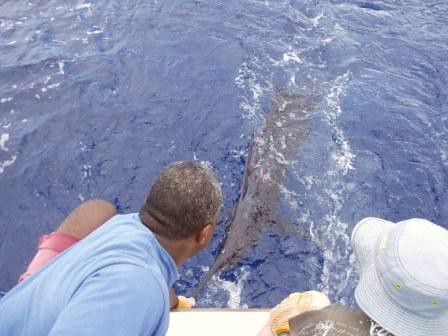
More of these guys around for future generations

There are many sustainable alternatives for restaurants and retailers to offer in place of billfish; thus most restaurants have taken marlin and other billfish off the menu.

25 Jun 2011

Good News for Costa Rica Billfish


First hotels and restaurants in Costa Rica sign

agreement to support billfish conservation


Initial group of Central American hotels, resorts and restaurants set example for others in promoting sportfishing ecotourism by taking sailfish and marlin off their menus


FT. LAUDERDALE, Fla. USA. – The Billfish Foundation (TBF) entered into an agreement with its conservation partner, the Costa Rica Sport Fishing Federation (FECOPT) and four participating Hilton Worldwide hotels in Costa Rica, pledging to stop serving all sailfish and marlin.

Based on a socio-economic study released last year by TBF showing the huge economic value of sportfishing tourism to Costa Rica, the participating hotels adopted the ban on billfish from their restaurants in part to promote responsible and sustainable tourism in the nation.

The four properties include the DoubleTree Resort by Hilton Costa Rica in Puntarenas, the DoubleTree Cariari by Hilton San Jose, the Hilton Papagayo Costa Rica Resort and Spa, and the Hilton Garden Inn Liberia Airport. The bold conservation move with the hotels and resorts came after two months of discussions with FECOPT Executive Director Enrique Ramirez.

“TBF is proud of the efforts by Enrique Ramirez who secured the participation of the four participating Hilton Worldwide properties in Costa Rica and explained the conservation and business benefits of the world’s sportfishing tourists, reaffirming Costa Rica’s stature as one of the world’s premier fishing destinations,” noted TBF Chief Scientist Dr. Russell Nelson. “We specially appreciate the foresight of the general managers at the participating Hilton Worldwide hotels in Costa Rica - Ricardo Rodriguez Gil, Laura Castagnini and Rui Dominguez - that supporting sportfishing conservation efforts are good for the oceans and good for business as well.”

“The participating Hilton Worldwide hotels in Costa Rica are leading the way for Costa Rica’s tourism industry to move toward new levels of support for sportfishing conservation practices,” said FECOPT’s Ramirez. “Using the impetus of our agreement with the participating properties we look forward to partnering with sustainable tourism tour leader Horizontes to let this precedent spread across the nation’s tourism industry.

TBF President Ellen Peel applauded the agreement as a new standard for voluntary conservation action in the private sector adding, “we’re very pleased to see tourism businesses and government tourism officials responding so positively to the facts and information presented by our socio-economic research conducted with the University of Costa Rica that clearly supports TBF’s message that good conservation can be good economics.”

TBF has been working with governments such as Costa Rica, Mexico, Peru and Panama to protect billfish, mainly from overfishing coastal fisheries by commercial interests, while implementing tag and release programs for sportsmen. Herbert Nanne of San Jose serves as TBF’s Central American Conservation Director.

Established 25 years ago, The Billfish Foundation is the only non-profit organization dedicated solely to conserving and enhancing billfish populations around the world. TBF's comprehensive network of members and supporters includes anglers, captains, mates, tournament directors, clubs and sportfishing businesses. By coordinating efforts and speaking with one voice, TBF is able to work for solutions that are good for billfish and not punitive to recreational anglers. To reach Dr. Nelson call 561-449-9637 or visit www.billfish.org


The Billfish Foundation is out there right now trying to preserve our billfish for future generations. Consider becoming a valued member Its all you need do to help.

15 May 2007

Sailfish – Treat’em Right and they will live to fight another day


The Billfish Foundation (TBF) has done a lot to promote billfish conservation and has been instrumental in shifting past catch-and-kill practises to Tag & Release in most parts of the world. We fully support TBF and Tag & release all billfish from our game boats, the only exceptions being a fish that is clearly a National or World record.

TBF have noticed an increasing tendency nowadays for some anglers to lift a billfish (particularly sailfish) out of the water to photograph the angler with his catch.

If you choose to Tag & Release, there are four very good reasons not to lift your billfish out of the water:

1. To state the obvious – Fish can’t breathe out of the water and a billfish brought to the transom will almost certainly be, at the very least, ‘out of breath’. If you lift the fish out of the water, you are starving the fish of oxygen just when it needs it most. Imagine running up a flight of stairs and then trying to hold your breath when you get to the top.

2. Fish have a protective coat of slime on their bodies that helps them fight infection and parasites. In hauling out a large fish and handling (even with gloves), you will inevitably damage or remove some of this coating.

3. The billfish’s skeleton is designed to support the fish in water – not in air. If you haul a sailfish over the transom and try to hold it up, you are probably causing internal damage which may later kill the fish.

4. A thrashing billfish in the cockpit? Are you nuts? It’s just going to injure itself and maybe you too! If the fish is so exhausted that it can’t kick, lifting it out of the water and starving it of oxygen is likely to be the last straw.

We have, in the past removed a couple of sailfish from the water for photographs. We don’t do it any more. Nowadays, we photograph all billfish in the water after the fish has been tagged and the hook removed. Photos are a wonderful reminder of past memories for our guests and even more so to see their catch gently swimming behind the boat before release. We recommend you consider following the advice of The Billfish Foundation not to remove your catch from the water.

The whole point of Tag & Release is to gather scientific information for future conservation purposes and to release the fish unharmed. If you haul a billfish out of the water, you are damaging and possibly killing the very thing you are trying to conserve and protect.

Not much sense in that is there?

28 Mar 2007

Circle Hooks: On again, off again?

The National Marine Fisheries Service (NMFS) has published a proposed rule that would suspend the requirement for using circle hooks with live or natural baits in all Atlantic tournaments featuring billfish categories. Curiously, the proposal states that the rule might be suspended of 2007 in order to take advantage of the conservation benefits that circle hooks afford through the increased survival of released fish. Read more about it here.

This issue might be critical to the ongoing review of the status of white marlin in relation to the endangered species act. The reaction to the circle hook requirement has ranged from full support to a demand for an exception for baits trolled with artificial lures.

This new rulemaking comes in reaction to the complaints about the requirement and may conflict with many tournaments that already have printed literature and rules for 2007.

Public comments on the rule are being accepted through March 30 via the following means:

E-mail: 0648–AV25@noaa.gov

Mail: NOAA/NMFS HMS Management Division, 263 13th Avenue South St. Petersburg, FL 33701.

Fax: 727–824–5398. Include the following in the subject line or envelope front: ‘‘Comments on Proposed Billfish Circle Hook Rule.’’

25 Mar 2007

Pacific Fishery Management Council to Consider Longline Allowance


At its upcoming meeting (April 6, SEATAC Marriott, Seattle Washington) the Pacific Fishery Management Council will make a recommendation on the request for an Exempted Fishing Permit that would allow a single vessel to use longline gear to target bluefin tuna, yellowfin tuna, bigeye tuna, albacore and swordfish in the waters of the coastal Pacific from California north to Washington.


Although this permit now includes a provision that would prohibit fishing in the Southern California Bight that includes the primary range of striped marlin in U.S. Pacific waters, The Billfish Foundation is opposing the issuance of this permit on the grounds that three of the target species (bigeye, albacore and yellowfin tuna) are either currently overfished or approaching the overfished condition. We do not believe that it is wise management to begin to explore the possibility of a new longline fishery on species that are currently subject to excess fishing mortality. Click here to see our letter and the list of options available to the Council.


You can contact the Council to provide your opinion on this issue by sending an email to: pfmc.comments@noaa.gov. Reference Agenda Item J.2 Exempted Fishing Permit (EFP) for Longline Fishing in the West Coast Exclusive Economic Zone in the subject heading of your email.


Join TBF or renew your membership today! Please visit our website at www.billfish.org.

5 Mar 2007

The Billfish Foundation (TBF) Report

The Billfish Foundation (TBF) carried out a review of all tag, recapture and release data for the 2005 calendar year and have reported their findings. Headline points were :

  • 11,261 Billfish reports were received of which 3,881 were releases of billfish without a tag.
  • 29 tags were recovered through recapture.
  • Sailfish made up the majority of recaptures
  • 5,242 tag reports identified hook type. Of those, 49% were circle hooks and 51% J hooks.
  • The longest period at large for a recapture was2,580 days (7 years) for a blue marlin tagged and recaptured in Puerto Rico

More info see The Billfish Foundation (TBF) website