
Its not common but occasionally I have the pleasure of taking a guest marlin fishing who's aim is not so much to catch a marlin, but to catch a BIG marlin. Some guests have been marlin fishing all around the world and are more interested in achieving a catch of note, rather than just another notch on the tag stick. To exclusively target that fish of a lifetime and by-pass all others takes dedication and an appreciation of all aspects of going out big game fishing, from planning and preparation to just plain enjoying being out at sea searching for that elusive monster.
I have yet to clap eyes on a grander in my spread though a colleague of mine of great experience tagged a blue last year in Kadavu waters. To quote him directly ' It was the biggest blue I have ever seen. Frightened the ******* life out of the crew when they saw her size. I recon she went 900lbs at least'. She was tagged and released. On a trip to the Kadavu seamount in November last year we saw an angry blue jump that would have easily gone 700lbs and a couple of years ago a colleague of mine tagged and released a black marlin on the Kadavu seamount that was estimated by the then editor of BlueWater magazine as being just shy of a grander. The Fiji All Tackle National Record for blue marlin is 447kg (983lbs) which was caught in 1997 on 80lb class gear.
It is clear that Fiji's elusive grander is out there but with very few charter boats with good quality heavy gear out looking for her, the landmark Fiji grander has yet to be caught.
When we do get that rare opportunity to exclusively target a monster, these are the lures we most commonly use: Top ' BFG ' 22 inch - MBT Lures
Left to right
Mouldcraft - Wide Range ' 12 inch
Marlin Magic - Mirror Big Dog ' 14 inch
John Lau - Linda ' 14inch - John Lau
John Lau - GoodHead ' 14 inch
Pakula - Smokin' Joe ' 14 inch
These are our main 'go to' lures for targeting the super-sized marlin. I should add that aboard Bite Me, we have a selection of some 40 odd lures of 12 inches or more. Guests sometimes ask us to run a full spread of Pakula lures such as the big Smokin Joe, Sprocket, Wombat etc or we sometimes run a full spread of 14 inch John Lau lures. A couple of other lures should get a mention. We often reach for the smaller but extremely effective Joe Yee Apollo but this does draw strikes from all sizes of marlin and worringly, a fair few wahoo as well. The big Top Gun ball bearing Nightmare has accounted for a number of large fish in other countries including an 800lb blue off Bimini in the Bahamas in 1999. The John Lau 12 inch Talibung in black / red / yellow is also very effective and has accounted for a number of very large blue marlin in Hawaii.
I have mixed feelings about targeting a trophy marlin. I thoroughly enjoy the opportunity to try, but know that I will be saddened if we ever have to weigh such a magnificent fish. One of my guests will catch that grander of a lifetime, set the Fiji National Record and I'll leave it at that. Having done so, I will be firmly back in the tag & release corner. Until that day, I intend on thoroughly enjoying seeing my anglers tag and releas all those 'nearly the one's.....
28 Apr 2008
Fiji Grander Blue Marlin
13 Jul 2007
Tricks Of The Trade - Yellowfin Tuna
Most of the lures we run here in Fiji are highly active lures. Marlin, sailfish, wahoo and mackerels all seem to prefer a noisy erratic lure with a strong bubble trail. Yellowfin are different. They will completely ignore a spread of active lures and hit the one lure that is just sitting quietly.
When we are out trolling lures for blue marlin on heavy tackle and one of the rigger lures is sitting quietly rather than smoking a bubble trail, I sometimes leave it alone. More often than not, it gets jumped by a big Yellowfin.
Bait Balls

It’s better to drop your lures further back, drive around the ball and then when your lures are on one side and the boat on the other, straighten up so your lures pass right through the area.
Getting a Strike
If the tuna are there on the sounder or on the surface but not striking your lures, put a tiny bullet, pink or black red or blue/pink out in the middle of the spread. Often the tuna are so focused on tiny baitfish that they ignore the larger lures. This little guy will draw a strike and then the rest of the shoal, thinking they are missing out on a meal, will follow the first fish into the spread and hit your other lures. If you can get just one to strike, you will immediately get multiple other hook-ups. You will be surprised at the size of fish that hit little bullets but don’t be tempted to rig them on heavy leader.
Sacrifice a little bullet and get the fish biting in your spread.
Fighting a Yellowfin
Don’t be shy about using butt pads, harnesses or even getting into the fighting chair. Yellowfin have an extraordinary power to weight ratio and unless you are sitting pretty in a harness or chair, you will quickly become tired. You will grip the rod and reel handle too tightly, your fore-arms will cramp up and you will start using bad posture. It’s all bad news for your back.
Patience. Don’t ramp up the drag and try to haul a Yellowfin out of the depths using brute force early in the fight. In my experience, chances are you will pull the hook or break something.
Landing a Yellowfin
When a Yellowfin starts to get tired, it turns on its side and begins to fight in a circular pattern. It is too tired to keep its head down against your drag setting so it keels over and swims round in circles. If you are skippering the boat, now is the time to earn your keep. A circling Yellowfin coming straight up under the boat will drag the angler’s line across the props & rudders and ‘ping’ – there goes your sashimi.
We drive away from tired Yellowfin in order to keep the fish behind and away from the hull. We put the angler in one corner and try to keep the fish circling off that corner as we work it in to the boat. It is also much easier for an angler to fight a fish that is some distance away from the boat rather than straight down.
A Few Tips from the Deck
Always try to gaff a tuna just behind the head – never towards the tail. If you do accidentally gaff a tuna in the tail, get the gaff out immediately because the tuna will take off and you will not be able to hang on. You will look pretty dumb as your gaff steams off away from the boat. We use a flying gaff for any fish over about 90lbs (don’t forget to tie off the end of the gaff rope to a good solid cleat!)

We bleed our Yellowfin by inserting a knife behind and under the gill plate and slicing the tuna’s heart. Some anglers nick the tail and then insert a blade behind the pectoral fins. I have seen several knife blades and tips sheered clean off doing this. If the tuna kicks when the knife blade is inserted, it will snap any type of fine blade filleting knife.
Costly and dangerous for whoever has to fillet the fish later.
Penn - Senator 9/0

11 Jul 2007
Lure Test - BFG

At about 22 inches in length (depending on how you trim the skirt) this lure is an absolute MONSTER. It’s the biggest lure we run on Bite Me and is in fact even larger than some of our teasers.
When we fish heavy tackle and troll lures for marlin, this is our automatic ‘go to’ selection for the short corner position. It’s a pusher style concave face lure which really punches its way through the water and repeatedly dives well under the prop wash. Its serious weight and length makes it stable in all weather conditions and therefore easy to run. No fiddling about trying to find the working tow height and drop back length just put it where you want it and it will smoke a big and I do mean BIG bubble trail up and down through the wash. Not only is it a screaming grander lure, its also a great big teaser for those days when there are just little blues about.
There is some debate as to what BFG stands for. I believe it stands for ‘Big Friendly Giant’ though most of my guests, upon seeing it, substitute a rather more colourful word in place of ‘friendly’.
Position: Short Corner
Rigging: 2 x 12/0 hooks on 500lb wire
Leader: 550lb Marlin Hard Moimoi, length depends on wind-on leader if used
Best colour: Match the hatch – what baitfish are around ?
Tips
I would not run this lure on anything less than one of our 80lb bent butt chair rods. Unbelievably, this lure has drawn strikes from fish as small as 150lbs. Just because a grander doesn’t climb on every day, don’t be tempted to change down to a smaller sized lure. This lure is as good as any teaser in the wake and will draw in all sizes of marlin. Run it as a teaser but be prepared for something huge to climb on board.
Maker – MBT Lures Australia
Website – www.mbtlures.com
14 Jun 2007
Pacific Blue Marlin – Lures that work here in Fiji

When trolling lures for Blue marlin aboard ‘Bite Me’, we run a standard spread of four lures off bent butt chair rods and use Penn International 80STWs. We run a long and short corner from the transom rod holders and a long and short rigger from the chair. Sometimes we run a teaser such as a spreader bar or a Pakula Witchdoctor.
We never run a shotgun. We always aim to tag & release all billfish and use Billfish Foundation tags.
We generally use lures that imitate or approximate to the baitfish in the area such as skipjack & Yellowfin tuna, mahi mahi or flying fish.
Although We use wire rigs a lot because of wahoo, we don’t double the wire inside the skirt to make a stiff rig. We just use a single wire to the hook allowing some flexibility and swing. Lures are tooth-picked or hooks set with the point or points upwards. Two hook rigs have the hooks offset at about 45 degrees.

Our recommendations are for normal general fishing on a reasonably calm day in bright or slightly overcast weather when targeting fish of any size. This is what works for us. Its not necessarily what will work for you !
SHORT CORNER
We tend to use this position more as a teaser or to tempt a monster fish with a monster lure.
1. MBT custom made monster – Silver over yellow – 2 x 12/0 wire shackle rig
2. Pakula Smokin Jo – Blue Silver/ Green Gold – 2 x 12/0 wire shackle rig
3. Marlin Magic Mirror Big Dog – Purple – 2 x 12/0 wire shackle rig
LONG CORNER
1. Hollowpoint Goblin – silver/green/gold – 1 x 12/0 wire rig
2. Pakula Rat – Black/Red – 2 x 12/0 wire shackle rig
3. John Lau Good Head – Blue yellow / Redyellow – 2 x 12/0 wire shackle rig
4. Top Gun Ball bearing Nightmare – Clear Purple tint in water / Black Gold – 1 x 12/0 wire shackle rig
SHORT RIGGER
1. Joe Yee Apollo – Evil – 2 x 11/0 wire shackle rig
2. Black Bart Hot Breakfast – Blue white / pink white (yellow stripe) – 1 x 11/0 wire rig
3. John Lau Talibung – Black/Red – 2 x 11/0 wire shackle rig
4. MBT Tulip – Blue white / White – 2 x 11/0 wire shackle rig
LONG RIGGER
1. Hollowpoint Cabo Killa – Purple – 1 x 10/0 wire rig
2. Mould craft Wide Range – Purple – 1 x 12/0 Wire rig
3. Pakula Sprocket – Lumo – 2 x 10/0 wire shackle rig (this lure picks up a lot of wahoo)
4. Wellseys Hypahead Large Talai – Black/Gold – 2 x 11/0 wire shackle rig
Where we get our lures :
Lure Manufacturer Links :
- Pakula lures
- Hollowpoint Lures
- Marlin Magic Lures
- Wellsys Lures
- MBT Lures
- John Lau Lures – Contact John at jaslau@yahoo.com
- Black Bart Lures
If you want to know what the top Australian skippers use, check out the lead article in the Feb / Mar issue of BlueWater magazine.
31 May 2007
Tricks Of The Trade - Belly Flap Teaser
It’s another beautiful day out fishing for Pacific sailfish along the Great Astrolabe barrier reef. You were off at dawn and now your two pink squid daisy chain teasers are skipping along in the wake, your party of anglers waiting patiently around the cockpit with their pitch baits ready for the first sailfish attack.
Suddenly a bill pokes out of the sea, right behind the left hand daisy chain and a sailfish has a couple of half hearted swipes at the teaser tail. Deckie Joe swings into action and starts to work the teaser back to the boat as the first angler pitches a bait and skips it back to the billfish…….But something is wrong…….The sail doesn’t light up and charge after the teaser. It takes one last swipe with its bill and slides away, disappearing off to the left.
It’s the New Moon and the sails are doing what they always do here around the New Moon…..Being finicky !
Here is a simple trick that we sometimes use to get them fired up and in the mood to eat:

Teaser Tail Belly Flap
Bring in the teasers and set a spread of small bullets, feathers and bibbed minnows. Head for the nearest skipjack or Yellowfin tuna.
Once you have one, cut a couple of belly flaps in a stretched diamond or ‘kite’ shape.
Take a bait needle and some waxed thread or cotton and stitch the flap in a criss-cross pattern from one end to the other. This is to hold the flap together in one piece and to stop it from tearing apart too easily.
Take the last squid or lure on your daisy chain and tie the thicker end of the belly flap to the end of your teaser line with a bit of waxed thread. Slide the lure down over the belly flap so that the belly flap is contained within the skirt. Its ok if a little bit of the thin end of the belly flap protrudes from the end of the skirt. We usually use a strip of tuna belly but Queenfish or Dolphinfish also work well. All these species have fairly tough skin that will hold up well to being trolled. Other baitfish also work but tend to break up after a short while.
When the next sailfish mouths the end of the daisy chain and gets a taste, they will almost always light up, charge the teaser and eat anything pitched back at them.
Works like a charm here in Fiji.
14 May 2007
Lure Test - YahooWahoo
About a year ago, Matava Resort Gamefishing was asked by Palm Fishing & Outdoors Australia to test and comment on a whole range of new skirted lures and bibbed minnows manufactured by Lurestreet in China. Palm Fishing was interested in stocking the best lures from the range and needed some field testing.
This of course gave my deckie Joeli and I the perfect excuse to jump in the inshore fishing boat on a quiet day with a fist full of new lures to have some fun….Sort of busman’s holiday you might say.
Over several months, we tried out everything from GT poppers to blue water skirted lures and a few of the lures impressed us sufficiently that they are now firmly part of our Gamefishing vessels available onboard lure rolls.
YahooWahoo
This blue water skirted lure was first run at the onset of our winter wahoo season when large packs of wahoo gather along the Great Astrolabe barrier reef. The lure is a sliced face heavy resin head with pearl inserts and a fairly large leader hole. It came to us from the factory with what looked like a rather mediocre quality 7 inch skirt but these are now being upgraded buy the manufacturer. Actually, it’s a marketing / cosmetic thing. Its common knowledge that half of all lures in tackle shops are designed to catch anglers not fish! We found the original test skirts worked rather well on the wahoo and we run these lures as they come until it needs replacing.
The test lures had brass tube inserts for the leader which can chafe mono however the manufacturer is changing this to a softer plastic lining.
The weight of the head makes this a higher speed lure and one that copes well with rough weather. At low speeds (4-6kts) it sits quietly and you are wasting your time for anything but tuna. Rig it on wire however and up the speed past 6kts and this lure comes alive in a big way. The narrow diameter wire through the large bore leader hole allows the head to shake violently causing the lure to duck, dive and headshake a huge erratic bubble trail. It’s a total wahoo magnet and during the wahoo season, we don’t leave home without it.
Position: Long Rigger
Rigging: Two hook 8/0 60 degree Semi-stiff rig.
Leader: At least 4 feet of 124lb Stainless Steel 49 strand wire
Best Colour: Green over Red as supplied or Lumo green

Make sure your leader is significantly smaller than the lure leader tube bore. If you suspend the lure by holding the leader, the head should be able to wobble about. Consider using a short piece of plastic tubing to protect the head where the leader exits the front end. The action can be so violent that the head will eventually chip with no protection.
Run this lure as far back as you can and watch the wahoo come porpoising in from 50 yards away.
Maker – Lurestreet
Distributor – Palm Fishing Australia www.palmfishing.com.au
6 May 2007
Tips On….Wahoo and Narrow Barred (Spanish) Mackerel– Saltwater Trolling baits and bait/lure combinations
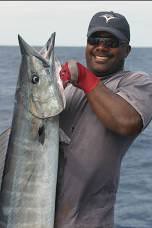
Deckie Joe displays a wahoo’s unusual ability to hinge both its upper and lower jaws
For us here on Kadavu Island, May to October is wahoo & sailfish season. Packs of wahoo congregate along the Great Astrolabe Barrier Reef and year round, we find Spanish mackerel. The average size of wahoo here is about 50lbs with a really good fish weighing in at 90 to 100lbs. The mackerel are common to20lbs but can reach 70lbs.
The trick here is to first find the wahoo packs by trolling a spread of lures. The wahoo packs are usually on one side of a reef point or the other, depending on the current direction. Normally the up-current side on the drop-off where the depth is about 250ft. Once a pack is found, we then usually switch to 2 outfits on light tackle, rigged with garfish (Ballyhoo). We troll one skip bait and one swimming bait. This prevents the expensive problem of getting mauled by a pack, having 5 rods go off with associated chaos on deck and loosing almost everything you have in the water. (I learnt this the hard way !)
Once you have several fish hooked up and screaming around on the surface, the whole back will attack and bite anything moving – including lines and snap swivels. A shotgun lure with all that belly of line in the water will be bitten off almost immediately.
Wahoo and Mackerel have razor sharp teeth so it is essential that you use wire trace on all lures and baits. We generally use at least 4 feet of 125lb 49 strand stainless steel wire. All snap swivels or other connections are blackened. Trolling speed is usually around 5kts with these bait rigs. The swimming bait is run in the long corner position and the skip bait is run from the opposite side rigger. That extra height allows you to skip the bait well back and out from the prop wash in clear water.
The wahoo normally come steaming in just under the surface but the mackerel usually attack from below. It’s common to see mackerel fly clean out of the water with the bait in their mouth.
Wahoo / Mackerel Lure / Bait Rig
Garfish (ballyhoo) on a two hook pin rig with a small pink skirt on the nose
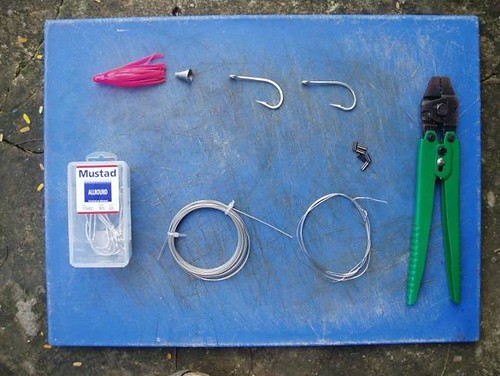
125lb 49 strand (7x7) wire
Stiff single strand wire
8/0 Mustad 7766 Duratin hooks
Bait spring or rubber band or waxed thread
#2 Figure 8 black brass crimps
Crimping tool
Small red/pink skirt or heavy bullet head lureThe Pin Rig
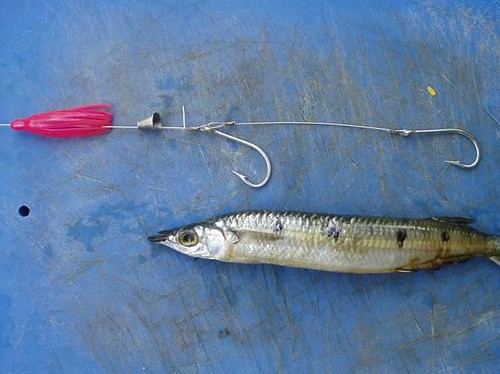 Making The Rig
Cut off a 1 inch piece of stiff single strand wire.
Take about 4 feet of the multi strand wire and crimp a hook to the end. Before you crimp, insert the small piece of single strand wire into the crimp pointing away from the hook. You may have to use a larger size crimp to accommodate the extra wire. Bend the end of the small wire so that with the hook pointing down, the wire points up at 90 degrees to the main wire leader.
Cut off a second piece of multi strand wire appropriate to the size of bait you have, crimp another hook on one end and crimp the other end to the loop holding the first hook.
Slide a bait spring onto the main line together with a small pink / red skirt and crimp a small loop at the end of your leader snap swivel.

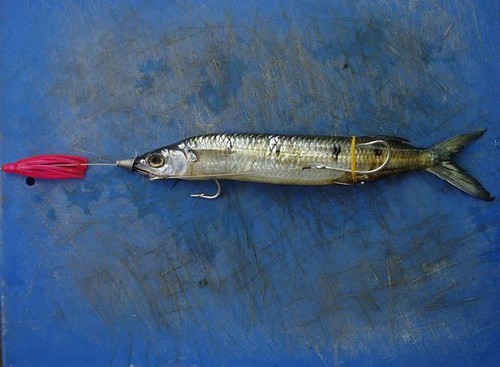
Cut the beak off the garfish. Take the leading hook, insert the point between the body and one gill plate and down inside the fish as far as you can. Bring the point out through the belly of the fish.
Take the pin wire and push it up through the bottom jaw and straight through the top jaw.
Slide the bait spring down and rotate it so that it catches the exposed part of the pin and snugs down onto the beak of the bait.
Firmly attach the trailing hook to the bait with a rubber band or waxed thread.
Slide the skirt down over the beak to cover the bait spring and provide a flash of colour to the bait.
Helpful Tips:
Try to get the leading hook coming out of the bait as centrally as possible and make sure the pin is central.
If either are off-centre, the bait will want to spin when trolled.
For skip baits, ensure the bait is skipping along with the exposed trailing hook and wire on the upper side, not the lower side the target fish see.
Prepare your rigs ashore then bait up when you are out there. It’s a lot easier.
If you are freezing fresh garfish for later, sprinkle them with salt. They keep much better.
Variations on a theme:
To make a swimming bait rig, we replace the little pink skirt with a heavy bullet head lure or a McWhog (available from Welsystackle http://www.wellsystackle.com/shop/ ) and flat-line the mainline from the rod tip using a #16 rubber band around the reel handle. On a strike, the rubber band snaps. Simple and effective but not suitable for ultra light tackle.
You don’t have to use the second trailing hook however most of the razor gang attack prey by taking the back end first then come around to finish off the rest of the sinking bait. Without that trailing hook you will miss a lot of hook-ups.
Instead of a bait spring, you can use an elastic band. Loop it over the pin, round the beak several times till its tight then put the end back over the pin. Alternatively you can use waxed thread. (Dental floss works just fine)
You can insert a hollow needle through the fish, feed a wire through and attach a hook to one end and crimp the other to the eye of the leading hook. This ‘buries’ the wire to the trailing hook inside the fish. Better presentation but a more fiddly job. We find the wire showing does not seem to put the fish off here.
We secure the trailing hook with a rubber band however you can conceal it by burying it in the belly of the fish. but occasionally this interferes with hook-ups.
Trolling Tips
Mackerel are often not hooked in the mouth but just nicked under the chin or the side of the head. We therefore fight mackerel on relatively light drag settings. If you try to bully a mackerel to the boat, there is a good chance you will pull the hooks and loose the fish. (This is especially important if you are trolling bibbed minnows with treble hooks)
Mackerel up to 20lbs usually school so if you find one, there are usually more in the same area. The larger fish are solitary.
Mackerel make excellent sashimi.
Wahoo come in at high speed and leave the scene at even higher speed. Start with a light drag setting (no more than ¼ line strength). If you try to stop a wahoo on its first run by upping the drag, you will bust it off. Wait for the end of the run, then ease the drag up a little and start working the fish in. If the fish makes another run – back off the drag again. Bear in mind that at the high speeds these fish can reach, line drag through the water can be significant and a sudden burst of speed from a wahoo can bust you off if your drag setting is over 1/3 line strength. When you are fighting a wahoo , you should be actively working the drag – especially on light tackle.
If you run a shotgun lure, make the wire trace extra long. When the shotgun hooks-up, you will have a lot of line in the water and it will get bitten by other fish.
Most wahoo fight near the surface. If your wahoo goes deep – it’s a big one.
Other Sources of information:
Special Review on Wahoo by Dr Julian Pepperell Feb/Mar 2007 issue.
In Depth look at the Narrow Barred Mackerel in the Dec/Jan 2007 issue www.bluewatermag.com.au
If you have any questions, drop me a line at Matava@connect.com.fj
6 Apr 2007
Hook Corrosion Rates in Salt Water

Well, undesirable as it is, it does happen and aboard our Gamefishing vessels, we always use hooks made from Duratin when using real baits, bait / lure combinations or in a lot of our wahoo and large marlin lures. Duratin, I explained, in contrast to Stainless Steel, corrodes rapidly in seawater so the hook quickly deteriorates and falls out or is ejected by the fish.
It then occurred to me that I had never actually seen a study of just how long it takes to corrode a hook to the point where it is likely to drop out or be expelled by a fish so I conducted an amateur bench test:
The following hooks were tested:
| HOOK | SIZE | USE |
| 1. Mustad 7766D (Duratin) – | 8/0 | rigged baits and skirted lures for wahoo |
| 2. Gamakatsu SL12S Saltwater fly big game hooks | 10/0 | Light tackle rigged baits for sailfish |
| 3. Mustad 39960D (Duratin) | 13/0 | rigged baits for marlin & sailfish |
| 4. Maruto SS1920-2X Stainless Steel | 6/0 | Small to medium skirted lures |
| 5. Gamakatsu Live Bait hooks, High Carbon Steel | 6/0 | Deepwater jigging / Bottom fishing |
| 6. Mustad 7794BD Treble | 1 | Small Bibbed Minnows |
 Each hook was crimped to 100lb monofilament line using a 1.6mm Brass double sleeve and suspended in a container of seawater. Containers were made from cutting the top off plastic drinks bottles, screwing them down to a bench and using the tops to hold the bottoms. The seawater was refreshed daily and the hooks inspected at the same time each day. To test, each hook was removed, held with the shank horizontal, point down and a weight of five pounds was suspended from the bend of the hook near the barb to see if it had weakened sufficiently to bend or break. In the case of the treble, the weight was suspended from only one of the hook bends.
RESULTS
Gamakatsu SL12S – Corrosion started within 1 day
Mustad 7766D – Corrosion started after 2 days
Mustad 7794BD Trebble – Corrosion started after 2 days
Mustad 39960D – Corrosion started after 3 days
Gamakatsu Live Bait – Corrosion started after 4 days
Thereafter up to day 10, apart from some continuing mild surface rust and furring on the Duratin hooks, everything seemed to stabilise and nothing much happened.
On day 10, the Maruto SS1920 Stainless Steel hook finally showed some discolouration and then on day 12, some minor rust spots on the eye and shank.
On day 14, all the hooks were tested with the 5lb weight and all passed with flying colours. There did not appear to be any deterioration in strength in any of the hooks.
After 21 days the hooks were removed, lightly wiped with a cloth, photographed and strength tested.
All hooks showed widespread corrosion except the Gamakatsu Live Bait and the Maruto Stainless Steel hooks which only showed slight corrosion on the hook barb and bend. The Duratin light gage SL12S was the most heavily corroded. A second SL12S that was dipped in salt water each day but suspended in air corroded far more heavily than the one suspended in salt water – presumably because of the increased levels of oxygen in air verses a still container of seawater.
Dispelling My Duratin Myth
 The results were a bit of a surprise. The Stainless Steel hooks performed as expected however the Duratin hooks lasted significantly longer that I thought they would. In fact, after 21 days suspended in salt water, despite some surface rust, they were as strong as ever. Even the barbs were still intact.
CONCLUSION
In reality, a hook in a fish’s mouth would have constant movement of seawater over its surface which would accelerate corrosion however the only way for us to test this would be to suspend the hooks in a live well.
I didn’t want all that rust in my live well !
I had observed that a Duratin hook, used at sea and put away without a wash in fresh water is basically useless within days. This led me to believe that, if left in a fish, the hook would deteriorate rapidly and fall out within days.
I was quite wrong. Duratin hooks survive much longer than you think. We will continue to favour Duratin hooks because they do rust out much faster than Stainless Steel hooks however I stand corrected on their rates of corrosion if lost fish. Its not a matter of days, it’s a matter of weeks.
4 Apr 2007
Tricks Of The Trade - Coke Can Teaser
Though we catch wahoo and sailfish all year round, May through to September is our hot bite season with numerous packs of wahoo and sailfish gathering all along the Great Astrolabe Barrier Reef.
When fishing for sailfish we usually use bait and switch tactics so often run teasers. We also sometimes run teasers when fishing baits or lure/bait combinations for wahoo.
Pacific sailfish are magnificent creatures and probably my all time favourite species to fish for. They feed determinedly and will chase a lure right up to the back of the boat, close enough that you could reach out and grab their bill (Not that I recommend this !).
When a sail lights up and charges a lure or teaser, it’s an extraordinary sight. On hook-up sails almost always take to the air and leap about, tail-walking away from the boat. It’s a sight to remember and if you have not yet seen it, I strongly recommend you experience the awesome and exciting display for yourself.
Coke Can Teaser for Sailfish
We mostly use bait & switch tactics for sails so we start out by trolling one or more teasers. When a pack of sails is raised, the teasers come out and the baits are fed back to the fish.
Teasers come in all shapes and sizes but we have found that the most effective teaser for sailfish is a daisy chain of three or four pink squid with a coke can rigged at the head of the chain. Yes, a coke can. Rig it so the bottom of the can runs first through the water.
Punch a small hole in the top and the bottom of an empty coke can. Remove the snap swivel on the front of the daisy chain. Crimp a stopper to the front end of the mono daisy chain line and slide the can down to the stopper. Re-attach the snap swivel to the front of the daisy chain and you are good to go.
Keep an eye on the mono around the coke can as it can suffer some abrasion from the can hole edges. We sometimes rig the can on a separate piece of mono or wire with a snap swivel at either end. That way we can change it out easily.
The concave shape grips the water and makes a huge ruckus in the prop wash. Cheap and very effective.
Coke Can Teaser for Wahoo
This teaser is exactly the same principal as above but we do away with the daisy chain and just troll two cans rigged close together in the prop wash.
Punch a hole in the top and bottom of each can. Take a two foot length of multi strand wire and crimp a stopper on one end. Slide on the first can. Crimp a second stopper about 6 inches ahead of the first can and slide on the second can. Crimp a snap swivel to the front and your teaser is good to go.
We run this teaser about 20 yards back so that it dives through and under the prop wash. It can usually survive several hits before it needs to be replaced but by then you should have put several nice wahoo on the deck. Works like a charm
We have experimented with several different types of can but the red coke can seems to be best, though I do know a charter boat skipper out of Sydney that swears by a blue and gold Fosters beer can when fishing for blue marlin…….
30 Mar 2007
Pacific Sailfish – Lures that work here in Fiji

When targeting Pacific Sailfish, we mostly use bait & Switch techniques or troll rigged skip baits. Sometimes however we want to cover more ground and increase by-catch of other species such as Wahoo, Spanish Mackerel, Yellowfin tuna and mahi mahi – so occasionally we run lures.
The Sailfish season coincides with the Wahoo season so all lures are rigged on 125lb 49 strand wire. Make the leader long or the sail will use the lure head weight to throw the hooks when he jumps. We tag 4 out of 5 sail hook-ups when using long leaders. We find our lure spreads work best at about 6kts in most weather conditions.
This is what works for us. Its not necessarily what will work in your neck of the woods !
SHORT CORNER
1. Wellsys Medium Talai – Purple or lumo green
2. Daisy Chain behind bird – Pink squid with blue/pink Mold craft Hooker on the end

LONG CORNER
1. McWhog – Blue/Chartruese – Rigged in front of a garfish (Ballyhoo)
2. Pakula Cockroach - Purple
SHORT RIGGER
1. Wellsys Medium Turbojet – Blue Silver / Green Gold (Evil)
(This is our absolute ‘must have’ in the spread)
LONG RIGGER
1. Hollowpoint Mahi Sniper – Blue/White or Silver/Pink
2. Pakula Phantom - Blue Silver / Green Gold (Evil) or Blue Angel
3. Pakula Sprocket - Lumo
SHOTGUN
1. Marlin Magic Kona Bullet – Black/Red
Where we get our lures :
Lure Manufacturer Links :
Above pictures by Tim Simpson – BlueWater Magazine
14 Mar 2007
Wahoo – Lures that work here in Fiji
From May to October, packs of wahoo congregate along the Great Astrolabe Barrier Reef. The average size of wahoo is about 50lbs with a good fish weighing in at 75lbs. Each wahoo pack usually has a fish of close to 100lbs. We almost always use lures when targeting wahoo however we often get jumped by fish when bait & switch fishing for sailfish. If your teaser is rigged with mono…wave bye bye to the end of your daisy chain….

The biggest problem we encounter is a mass attack, wahoo porpoising in at break-neck speed, every rod in the spread going off and then multiple bite-offs as other wahoo attack lines or swivels cutting through the water. We combat this by trolling a full spread until we find a pack and then switch to towing just two lures. Often, just a garfish (ballyhoo) on a two hook rig with a small pink skirt on the nose. Trolling speed is usually around 6-7kts. Most wahoo skippers around the world troll faster. Here, higher speeds do not increase strike rates. Last week on the Kadavu Seamount, we were feeding a skip bait back to a small blue marlin and a 60lb wahoo hit a Lumo green Pakula Sprocket that was only doing about 2kts.
All lures are rigged on at least 4 feet of 124lb 49 strand wire. (Longer if we think sails are in the area) At this time of year, if it isn’t on wire, it isn’t coming back….
SHORT CORNER
1. Wellsys Talai – Purple or lumo green
2. Halco Laser Pro 190 minnow - Redhead
LONG CORNER
1. McWhog – Blue/Chartruese – Rigged in front of a garfish (Ballyhoo)
2. Lurestreet Raptor minnow – Green/gold or Red/white
SHORT RIGGER
1. Wellsys Medium Turbojet – Blue Silver / Green Gold (Evil)
(This is our absolute ‘must have’ in the spread)
LONG RIGGER
1. Lurestreet Yahoowahoo – Black/green/red (I have seen wahoo charge this lure from 100 yards away)
2. Pakula Phantom - Blue Silver / Green Gold (Evil)
3. Pakula Sprocket - Lumo
SHOTGUN
1. Hollowpoint Mahi Sniper – Black/green or Black/red or White/pink
Where we get our lures :
Lure Manufacturer Links :
7 Mar 2007
What Went Pear Shaped # 1
Trolling Lures for Pacific Blue Marlin
Although most of the Gamefishing my clients enjoy aboard Bite Me at Matava is light to medium tackle, I occasionally get the opportunity to break out the bent butt 80s and go after marlin. Every encounter with these monsters is a learning experience. We have learnt a few things along the way and for what its worth, I will be posting a few examples. You can learn from them, or laugh at them. I recommend both.
2.30pm heading away from the Kadavu Seamount
1. Trolling a spread of 4 lures near the Kadavu seamount – A purple Hollowpoint Cabo Killa on the long rigger, and a blue/white/yellow/pink Black Bart Hot Breakfast on the short rigger, both lures with a single 10/0 Stainless steel hook stiff rigged on wire. 19 feet of 400lb wind-on and 9 feet of 300lb Ande leader. Short and long corners were a huge silver / yellow custom MBT Monster and a John Lau Linda, both 12/0 double hook loose shackle rigged at about 45 degrees. (Pakula style)
A large blue of about 600lbs comes in from the right, nails the short rigger, (skipper guns the boat) then crosses over and nails the long rigger as that lure passes her as well. Two Penn International 80s howling. The fish then charges away in the opposite direction to the boat on the surface for a few seconds and then disappears. (Pandemonium on deck- is it a double hook-up? Who goes in the chair ? – lots of yelling coming from the bridge). Angler standing by each rod till we find out exactly what’s going on. (I know I know, immediate failure to comply with IGFA Rules - but you try standing and indefinitely holding a screaming bent butt 80 with 25lbs of drag – Hays Handle or not) 5 seconds later the blue emerges only 40 yards behind the boat and launches vertically clean out of the sea giving everybody a magnificent image of a huge blue, side on, silver and golden flanks, 15 feet in the air. The blue seems to hang, suspended in the air whilst 6 jaws hit the deck then crashes back in a fit of anger, throws both lures and disappears. Anglers wind in tangled mess of two lures with both leaders heavily scuffed for several feet ahead of each lure. One of the hooks had its point bent.
- Well, we went to the right place. (had another small blue earlier on a skipbait)
- We ran the right lures in the right colours. (lures imitating the skipjack tuna and mahi that were in the area)
- Our hooks were sharp
- We gunned the boat after the strike to help set the hook.
What went wrong
- Single hook stiff cable rig is not the way to go. The blue was able to throw both lures. If they had been rigged with a 2 hook loose shackle rig, the trailing hook may have swung over or under the bill and given us a hook-up. If we had still run single hook rigs (because of extra weight killing the lure action) it might have been better if we had not used a stiff wire rig and used heavy mono instead, allowing the hook to swing a little.
- One of the hooks had its point bent. It had tried to penetrate but the point area, being very sharp, was also thin compared to the gauge of the hook. The line pressure must have been trying to set the hook at an angle to the direction of the hook point and instead of driving the point in, it bent it.
“In my humble opinion”
If you are fishing for blue marlin, I recommend a two hook rig or a single hook set well back in the skirt and rigged on heavy mono to give it some flexibility. Yes, a 2 hook rig can pin a marlins jaws shut so you absolutely must remove the hooks and yes- a big mahi mahi on the deck with one hook in its mouth and another flailing around is a nightmare for any deckie but if you are worried about that, go with a single Duratin hook on mono. (we do worry about that)
Don’t hone your hook points so much so that the point is long and thin. By all means have a sharp point but keep that point length shorter rather than longer.
As to whether or not you should use hooks where the point is parallel to the shank (like the Shogun T481 or Maruto 1983) or turned in slightly towards the shank (like the Mustad 7691 or Maruto 1962) ?
Jury is still out. I know some skippers use one of each in their large lures with the trailing hook being the turned in style.
I suspect that the whole issue of hook rigs in large Marlin lures is a hotbed of discussion. I have posed the question to Tim Simpson, the Editor of BlueWater magazine. It may be that the next issue of the magazine has some interesting comments from professionals such as Peter Pakula.
Oh, by the way – the Feb/Mar issue has a lead story on the top Blue marlin skippers favourite lures and how they like to rig them. www.bluewatermag.com.au


